Daily Office, Musings, Prayer, Scripture, Sunday

Psalm 37: One of My Favorite (and Most Challenging) Psalms-Part 1

I’m not sure if choosing favorite parts of the Bible is like choosing which child you like more, in that it is sort of taboo. As I don’t yet have children, parents will have to fill me in on this as it relates to their kids, but I do know I certainly have favorite passages in the Scriptures.

Psalm 37 continues to be at the top of the list, and it continues to speak afresh to me in different seasons of life. I thought I’d share a few reflections and see if they resonate with you as well.
Here is how it begins:

Do not fret because of evildoers,
Be not envious toward wrongdoers.
For they will wither quickly like the grass
And fade like the green herb.

In light of our new President’s first few days and actions in office, this is incredibly timely for me. I will not mince words: there are several of his actions or words that are not simply controversial or divisive, they are wrong. Torture is wrong and evil, regardless of its “effectiveness”. Denying help to the refugee is wrong, especially upon the basis of religious affiliation. Ignoring environmental concerns for the sake of “expediting development” is wrong. And this is just in the last few days.

For me, it becomes incredibly disturbing and frustrating. And I have been fretting…a lot. The psalm will speak more to those who do evil, but it offers an important positive alternative, and no–it is not, “Don’t worry, be happy.”

Trust in the Lord and do good;
Dwell in the land and cultivate faithfulness*.
Delight yourself in the Lord;
And He will give you the desires of your heart.
Commit your way to the Lord,
Trust also in Him, and He will do it.
He will bring forth your righteousness as the light
And your judgment as the noonday.

Instead of fretting, we are offered the alternatives of trust, dwell, cultivate, delight, and commit.

This verse has been printed out and framed in our house, becoming a sort of mission statement for Kara and I. We see it each time we walk out our front door.

Trust God. Dwell in the neighborhood. Cultivate faithfulness. Delight in God. Commit our lives to God.

When I fret, I am reminded that my calling has not changed. I am still invited to actively trust God by continuing to root myself in the place I live, to be faithful in loving my neighbors, and to take delight in all that God is. This, of course, is not simply a way of ignoring the reality of wrong-doing (there was just a violent incident in our neighborhood last night). This is also not being silent when speaking out becomes necessary. But worrying can keep me from being active from a posture of trust. Worrying fuels my work in a stressing and dangerous way. Fretting can make me very cynical and angry and bitter. Instead, I feel that God is inviting us to use our imagination more positively.

My question today is: How is God inviting me to cultivate faithfulness and to be fully present in the world around me, while also actively trusting him along the way?

*Note: I chose this translation because of this phrasing, though some translations say something more like “feed on faithfulness” or “befriend faithfulness” or even “find safe pasture”; all of which bring up interesting concepts.

Standard
Daily Office, Musings, Prayer, Scripture, Sunday

Daily Office Reflection: The Conversion of St. Paul

If you would like to read through the Daily Office, complete with prayers and hymns, I use this almost every day.

January 25th, 2017

Epiphany III-Commemoration of the Conversion of St. Paul

(Ps. 19; Isa 45:18-25; Phil 3:4-11-2:10)
The readings are a bit different today as we focus on the dramatic conversion of Saul of Tarsus to become Paul, the Apostle to the Gentiles.

Philippians 3:4-11

even though I, too, have reason for confidence in the flesh. If anyone else has reason to be confident in the flesh, I have more: circumcised on the eighth day, a member of the people of Israel, of the tribe of Benjamin, a Hebrew born of Hebrews; as to the law, a Pharisee; as to zeal, a persecutor of the church; as to righteousness under the law, blameless.
Yet whatever gains I had, these I have come to regard as loss because of Christ. More than that, I regard everything as loss because of the surpassing value of knowing Christ Jesus my Lord. For his sake I have suffered the loss of all things, and I regard them as rubbish, in order that I may gain Christ and be found in him, not having a righteousness of my own that comes from the law, but one that comes through faith in Christ, the righteousness from God based on faith. I want to know Christ and the power of his resurrection and the sharing of his sufferings by becoming like him in his death, if somehow I may attain the resurrection from the dead.

Paul has a certain intensity, doesn’t he? I mean, I find myself reading this passage and thinking, “Woah, Paul…I mean…it’s ALL ‘rubbish’?” He was super credentialed. He not only knew the Law, he was zealous for it. Paul was passionate.

I am helping to lead a training with HopeSprings about how we can do “wholistic” (i.e. concerned about the wholeness of people) ministry, and we talked about passion the other night. We tend to equate passion with zeal and drive, and this is certainly true. However, the original use of the word passion was in reference to suffering (think, the Passion of the Christ).

In Acts 9:16, when the Lord is speaking to Ananias, he says of Saul (about to be Paul) that he will show him how much Paul “must suffer for my name.” Paul’s passion (zeal) was transformed into a suffering for the sake of Christ and others.

When we choose to follow Jesus today, we embrace passion, our passion (suffering) of holding loosely to things which often define us (education, social status, bank account, denominational affiliation, family heritage, etc.) even, by comparision, considering them “rubbish” (a G-rated translation, to be sure) to the value of being in relationship with Christ. When we want to be what JEsus is about, the other things just don’t matter like they once did.

What is God inviting you to reconsider in your own life? In what ways does your own identity inhere within the things many would value? What is God saying to you about who you are, right now?

Imagine what our own callings could look like were we to value connection and relationship to Jesus more than these things.


Standard
Daily Office, Musings, Prayer, Scripture, Sunday

Daily Office Reflection: Galatians 1:18-2:10

If you would like to read through the Daily Office, complete with prayers and hymns, I use this almost every day.

January 24th, 2017

Epiphany III

(Ps. 45; Isaiah 48:12-21; Galatians 1:18-2:10;  Mark 6:1-13)

Galatians 1:18-2:10

Then after three years I did go up to Jerusalem to visit Cephas and stayed with him fifteen days; but I did not see any other apostle except James the Lord’s brother. In what I am writing to you, before God, I do not lie! Then I went into the regions of Syria and Cilicia, and I was still unknown by sight to the churches of Judea that are in Christ; they only heard it said, ‘The one who formerly was persecuting us is now proclaiming the faith he once tried to destroy.’ And they glorified God because of me. Then after fourteen years I went up again to Jerusalem with Barnabas, taking Titus along with me. I went up in response to a revelation. Then I laid before them (though only in a private meeting with the acknowledged leaders) the gospel that I proclaim among the Gentiles, in order to make sure that I was not running, or had not run, in vain. But even Titus, who was with me, was not compelled to be circumcised, though he was a Greek. But because of false believers secretly brought in, who slipped in to spy on the freedom we have in Christ Jesus, so that they might enslave us- we did not submit to them even for a moment, so that the truth of the gospel might always remain with you. And from those who were supposed to be acknowledged leaders (what they actually were makes no difference to me; God shows no partiality) -those leaders contributed nothing to me. On the contrary, when they saw that I had been entrusted with the gospel for the uncircumcised, just as Peter had been entrusted with the gospel for the circumcised (for he who worked through Peter making him an apostle to the circumcised also worked through me in sending me to the Gentiles), and when James and Cephas and John, who were acknowledged pillars, recognized the grace that had been given to me, they gave to Barnabas and me the right hand of fellowship, agreeing that we should go to the Gentiles and they to the circumcised. They asked only one thing, that we remember the poor, which was actually what I was eager to do.

So, this account of Paul’s calling and ministry and how he worked through being received into the community of Jesus, especially considering his past. This seems like a key moment in the movement of Jesus, as they acknowledge that the same God who entrusted a calling and mission to Peter to one group of people (Jews and God-fearing, law-keeping Gentiles) was the same God who was sending Paul to the Gentiles (aka: everyone else!).

Different callings are key to seeing God’s one, great mission unfold.

But notice the one commonality: remember the poor.


As my grandfather (a Southern Baptist preacher)  likes to put it, “We all have our rows to work in the vineyard.” Yes, and amen. But let’s remember the poor, the outcast, the foreigner, the widow, and the orphan. Perhaps we need to confess that much of our time is spent forgetting, not remembering the poor. What would it look like for us to be eager to remember the poor? Let’s not get so caught up in our callings today that we forget the poor, the one thing all of our ministries should have in common. 

“And when you reap the harvest of your land, you shall not reap your field right up to its edge, nor shall you gather the gleanings after your harvest. You shall leave them for the poor and for the sojourner: I am the LORD your God.” (Lev. 23:22)

Standard
Daily Office, John, Musings, Prayer, Scripture, Sunday

Daily Office Reflection: Psalm 41 & 52

Today continues this practice of praying and reflecting on the Daily Office readings.

January 23rd, 2017
Epiphany III

(Ps. 41, 52; Isaiah 48:1-11; Galatians 1:1-17;  Mark 5:21-23)

Psalm 41 &52

Psalm 41
Happy are those who consider the poor;
the Lord delivers them in the day of trouble.
The Lord protects them and keeps them alive;
they are called happy in the land.
You do not give them up to the will of their enemies.
The Lord sustains them on their sickbed;
in their illness you heal all their infirmities.

As for me, I said, ‘O Lord, be gracious to me;
heal me, for I have sinned against you.’
My enemies wonder in malice
when I will die, and my name perish.
And when they come to see me, they utter empty words,
while their hearts gather mischief;
when they go out, they tell it abroad.
All who hate me whisper together about me;
they imagine the worst for me.

They think that a deadly thing has fastened on me,
that I will not rise again from where I lie.
Even my bosom friend in whom I trusted,
who ate of my bread, has lifted the heel against me.
But you, O Lord, be gracious to me,
and raise me up, that I may repay them.

By this I know that you are pleased with me;
because my enemy has not triumphed over me.
But you have upheld me because of my integrity,
and set me in your presence for ever.

Blessed be the Lord, the God of Israel,
from everlasting to everlasting.Amen and Amen.

Psalm 52

Why do you boast, O mighty one,
of mischief done against the godly?
All day long you are plotting destruction.
Your tongue is like a sharp razor,
you worker of treachery.
You love evil more than good,
and lying more than speaking the truth.
Selah
You love all words that devour,
O deceitful tongue.

But God will break you down for ever;
he will snatch and tear you from your tent;
he will uproot you from the land of the living.
Selah
The righteous will see, and fear,
and will laugh at the evildoer, saying,
‘See the one who would not take
refuge in God,
but trusted in abundant riches,
and sought refuge in wealth!’

But I am like a green olive tree
in the house of God.
I trust in the steadfast love of God
for ever and ever.
I will thank you for ever,
because of what you have done.
In the presence of the faithful
I will proclaim your name, for it is good.

The parallels to currents events are too large to ignore. Before offering a few thoughts, I believe that these two Psalms speak to something of fundamental importance: the formational power of consistent liturgical prayer. What do you think the impact could be upon the Church (and the world!), were she to mindfully pray the words we read above:
“Happy are those who consider the poor;
the Lord delivers them in the day of trouble.”
and
“Why do you boast, O mighty one,
of mischief done against the godly?
All day long you are plotting destruction.
Your tongue is like a sharp razor,
you worker of treachery.
You love evil more than good,
and lying more than speaking the truth.”

In a world which values the rich, the powerful, the boastful, and the extravagant, these words speak prophetically to the Church and to the world. In a time where we have phrases like “fake news” and “alternative facts”, how can we continue to turn to those who do not have the power of political voice, news spin, or material wealth and consider their health and well-being, even more than our own?

Could it be that we have come to believe a different gospel, particularly in North America/United States? Does this relate at all to St. Paul’s words in Galatians about gospel? What would the truly “good news” be based on these readings?

Speak, Lord…your servants are listening…

Standard
Daily Office, John, Musings, Prayer, Scripture, Sunday

Daily Office Reflection: An Intro and John 5:2-18

For a couple years now, I have been engaging in the practice of praying the Daily Office from the Book of Common Prayer. This last year, I journaled through the an entire year of the Daily Office lectionary, taking time to read the prayers, the appointed Psalms, the assigned lessons for the day (One Old Testament, One New Testament, One Gospel), confess the truth of the Church through the creeds, and pray the same prayers for the world along with many in the Church.
Along the way, there have been some profound moments, to be sure. I have seen things I had not seen before. I have felt the presence of God, at times, in new ways. But to be honest, most of the time it was quite ordinary and uneventful. It simply became a quiet habit. But I do believe it was a good habit which has and continues to do good work in me; albeit slow, steady, and ordinary work. I read a quote this morning from Brené Brown, who says:

Joy comes to us in ordinary moments. We risk missing out on joy when we get too busy chasing down the extraordinary.


So, this is an endeavor in the ordinary and an invitation for you to, perhaps, join me. Someone recently encouraged me to continue sharing some of the things I am learning, so I will be sharing some reflections on at least one of the texts from the Daily Office lectionary on a regular basis. It probably won’t be every day. But, I hope at the very least, it encourages you to take some steps of ordinary, regular engagement with God each day, trusting that God will meet you there with joy in surprising and common ways.
There are a few different ways you can access these readings online. If you want to have access to many of the prayers, hymns, and canticles which go with the readings, Mission St. Clare is a great resource I often use when I don’t have my BCP around. (¡Disponible en español, también!) If you just want the Scripture readings for each day, you can go here.
One last note: I would love to hear from you if you are praying this with me, or if you have thoughts from the readings/time of prayer. Feel free to comment or contact me directly.

January 22nd, 2017: Third Sunday after Epiphany

(Ps. 63:1–8 (9–11) Ps. 98; Ps. 103; Isa. 47:1–15; Heb. 10:19–31; John 5:2–18)

John 5:2-18

Now in Jerusalem by the Sheep Gate there is a pool, called in Hebrew Beth-zatha, which has five porticoes. In these lay many invalids—blind, lame, and paralyzed. One man was there who had been ill for thirty-eight years. When Jesus saw him lying there and knew that he had been there a long time, he said to him, “Do you want to be made well?” The sick man answered him, “Sir, I have no one to put me into the pool when the water is stirred up; and while I am making my way, someone else steps down ahead of me.” Jesus said to him, “Stand up, take your mat and walk.” At once the man was made well, and he took up his mat and began to walk. Now that day was a sabbath. So the Jews said to the man who had been cured, “It is the sabbath; it is not lawful for you to carry your mat.” But he answered them, “The man who made me well said to me, ‘Take up your mat and walk.’” They asked him, “Who is the man who said to you, ‘Take it up and walk’?” Now the man who had been healed did not know who it was, for Jesus had disappeared in the crowd that was there. Later Jesus found him in the temple and said to him, “See, you have been made well! Do not sin any more, so that nothing worse happens to you.” The man went away and told the Jews that it was Jesus who had made him well. Therefore the Jews started persecuting Jesus, because he was doing such things on the sabbath.
But Jesus answered them, “My Father is still working, and I also am working.” For this reason the Jews were seeking all the more to kill him, because he was not only breaking the sabbath, but was also calling God his own Father, thereby making himself equal to God.


There were just a few thoughts to offer:

First, Jesus takes the time to go be amongst the hurting, sick, and hopeful. These people are here at Beth-zatha because they believed that these pools were sacred places where healing could take place. And such beliefs were not in line with the First-Century Jewish Temple system. These were people who needed healing and were on the fringes of social and religious life.

Second, the man that Jesus interacts with and heals is VERY old by standards of that day. And has obviously had failed attempt after failed attempt to be healed. He is even marginalized by the marginalized. But Jesus asks him an important question: Do you want to be well? If so, show me by taking up your mat and walking! And he does. This shows the cooperation of our faith-full response and the mighty work of God..

Third, the religious elite will try to find anyway to disparage the work of God, as they call out a man who was miraculously healed for breaking the technicality of the the sabbath law!

And finally, the huge statement that stuck out to me wasJesus’ discussing the work of his Father. “My Father is still working, and I also am working.” I imagined that God said the following to me (and it was very timely): I am not done working in my world, so neither am I done working in and through you. Will you decide to join me today, my son?”

If this story exemplifies the work of God in the world (to the marginalized, sick, and oppressed), will we be like Jesus and work with our Father? How can you join God’s work around you today?

Standard
Baltimore, church, Life, Musings, Neighborhood

An Important Life Update and Transition

[Greetings, all. I have communicated the below information to my congregation, colleagues, and some friends. However, I realized that it may be beneficial to share this in a more broad manner to those with whom I’ve connected through ministry, neighborhood life, friendship, and the many other ways our life paths cross. The quick version is this: I’m stepping down from my position as neighborhood pastor at Gallery Church Patterson Park to enter a time of preparation and focus for what may be next.]

[One thing I’ve realized is that there are far too many ways to communicate, and it is impossible to engage these media without having some of you be inevitably left out. I sincerely apologize if you are one of the ones who feel left out. If nothing else, it may just indicate that we need to connect in other ways!]

So, what follows is the letter I wrote to my congregation. Feel free to reach out to me with questions. If you are the praying type, I would appreciate your prayers as we step into a new season of life.

Dearest Gallery Church Family:

After much prayer, consideration, wrestling, and discernment—and with the blessing of other leaders, elders, and my wife, Kara—I am resigning as the neighborhood pastor of Gallery Church Patterson Park. I share this news with a sad and heavy heart and with a hopeful expectation for the future.

Almost nine years ago, at Pastor Ellis and Ginger Prince’s invitation, I moved to Baltimore with a handful of other people to help start the Gallery Church. We believed that a small group of people, with love in their hearts for God and their neighbors-to-be, could see real change happen in our neighborhoods. I still believe it, and what is more, I have seen it. Our God has been at work in his people in our city.

Since then, I have had the opportunity and responsibility to serve our church and city in so many ways. I am amazed and humbled as I think of those with whom I have had the privilege of serving. I cannot adequately state how much I have learned in my time serving with Gallery Church. I have been changed profoundly during my time here. I discerned a call to vocational/pastoral ministry here and have truly grown up here, spending almost a third of my life in ministry with Gallery. This church has taught me what it can mean and look like to walk together in challenging and joyful times.

And now, this journey continues for me. In transitioning from this position, Kara and I are taking a step of trust with the Lord. We do not have another church job lined-up. We are not planning on moving, but we are going to be entering a time of preparation. I will be investing some more time in my schooling to finish my degrees. I will continue to work part-time with HopeSprings, and I will be taking time to re-discover and seek clarity in my identity and calling. We sense that this is a necessary and important time for whatever lies ahead. What form that calling/vocation may take in the future, we are unsure, but we have a strong and enduring peace about taking this step, knowing full well it will be difficult and challenging for us and others.

Let me help to speak to a few questions or thoughts that you or others may be having. Many pastors tend to resign in the midst of controversy, that is not the case here. I want to be as clear as I can here: I have not had any sort of moral failure which would disqualify me from ministry. Kara and I are doing well in our marriage, growing in our love for each other and the Lord, and are united in this decision.

Additionally, there are not any secret or unsaid reasons for my resignation. In times like this, rumors can abound and certain “gaps” in the information can be filled in with gossip or speculation. There is not any enmity between me, or any of the leaders or staff in our Gallery Church Family. I have been challenged and blessed by the diversity of our staff team and by those with whom we have labored in our city. I love them, believe in them, and no difference of opinion or issue has contributed to this decision. I believe in what God is doing at Gallery and in our city, and I pray for God’s greatness to be continually displayed in our church family.

Lastly, some of you may be wondering if we will still be “around”—meaning, attending at Gallery Church in the coming months. We have no desire to “cut-ties” with Gallery. We still view you all as dear sisters and brothers and neighbors, so you will see us from time to time. Pastor Ellis has been very gracious and kind to continue to offer times for me to be with you, and to use my gifts when appropriate. We will be taking a few months to seek continued counsel, to worship with other faith communities in our region, and to pray through our family’s rhythms of life. We also feel that some initial “distance” will be the best way to love our Patterson Park family as they collectively discern what God is doing next. My last Sunday serving as the neighborhood pastor at Gallery Patterson Park will be January 15th, 2017.

Gallery Church Patterson Park has a unique and specific calling to uncover and run after. I truly believe that, and I believe God is already at work to provide for this next season. One of the benefits of belonging to a wider church family is that we have sisters and brothers who can support and walk with you in this time of transition. Jayme Swanson (our neighborhood elder), Pastor Bill Medina (our Associate Pastor), Aida Medina (Cross-Cultural Ministries), and Pastor Ellis will be working together with other key leaders at Patterson Park, and our Central Ministries team to help lead and serve the church in this next season. They will be ensuring that our gatherings and growth community life continue on with care and oversight.

So here is what I will ask you to consider doing in the coming days:
Pray— I know this sounds like the thing you are supposed to always say, but I could not be more emphatic. God has desires for Gallery Church Patterson Park that he wants to make known. There will be an upcoming time of Prayer and Fasting with Gallery Church Downtown from Jan 17-21 each evening. I encourage you to take time as a church family or as a growth community to come and to pray for Patterson Park and what’s next.
Invest— It is in times like this where the members of the church can sometimes sit back and wait to see what will happen. I encourage you to take this as a season of investment, both financially and spiritually. Please continue to give faithfully and sacrificially. Please take the time to get involved in serving. This is your time to be the church you hope to see.
Ask— Times like this can bring up questions and sometimes confusion. It’s more than ok to ask questions. I cannot promise we have an answer to every question, but we will listen and be available as much as possible until we transition in January.

This letter is not easy to write. Kara and I have felt grief and sadness as we have struggled with this decision, and we have wrestled with how to love you best during this time. I love you all and I am so thankful to have had the privilege to serve as your pastor over these last years.

May God’s Grace and Peace be with you,

Derek H. Miller
Advent, 2016

Standard
Musings, Politics

Election Reflection #1

The night of the election, as it became clear that Donald Trump would be our new President-elect, my mind and heart were racing. People were flashing into my mind and I was immediately wondering: “What are they thinking right now? How do they feel?” This, of course, was on top of my own feelings about the results, as well.I didn’t have to wonder long, thanks to Facebook and Twitter. Posts filled my news feeds of elation and exasperation, joy and deep despair and fear.


“I’m with Him, and He was put in office 2,000 years ago…”

There was one common thread I noticed first in some of the language of the posts. It was usually some version of “God is sovereign,” or “Jesus is still on the throne,” or “God works all things together for the good.” I had two thoughts as I read this. The first was: “Yes, that’s true.” The next came out as a burst of reflective tweets that I sent out that night. The first said this:

“reflections on this shocking night. 1)Many who are quick to say we need to not worry/trust God w/ results haven’t had to worry about much b4”

What I was seeing is that many who were saying this were people of considerable privilege. In an election where so much of the news making headlines have had to do with racial issues, immigration, and, to be frank, a lot of hate-filled language, I was wondering how people who were underprivileged or on the receiving end of much of the hate language were feeling about Jesus still ruling the world.

But here is one thing I have realized, I may be right about this statement I tweeted, but I also know I am definitely wrong about this, too. Ironically, my own privilege caused me to miss something way more profound: some of the most marginalized and oppressed people in our country are saying the very same thing—that they trust God with the results and are undeterred by them.

My sister and I were processing this together, and our conversation showed this fact to me. I am astonished at the profound depth of faith of many of my brothers and sisters who have endured disappointment and being maligned by many.

I don’t have a neat bow to tie this all up, but one thing I do know: I have learned way more from talking to people face-to-face about this and seeking to understand them. While I feel a bit sick to my stomach when people share truisms like the ones above about “God being in control” or “On the throne”, when it comes from someone who has way more reason to resent others in power, and they respond in quiet confidence and love, I know a great Power is at work in them. And it makes me long to have some of it.

**Feel free to comment or add some thoughts, just please know that I reserve the right to delete comments that get nasty or ridiculous. I am totally fine with disagreement (I am sure I’m wrong about lots of things and that we won’t agree about which things!), but let’s please be human and seek understanding. Cool? Cool.

Standard
church, Musings

A New Season of Ministry/Life/Vocation

I am starting to learn how slow some of the good things in life can be. The best meals take a long time to prepare and some of us best enjoy them slowly with the good wine or beer that has taken a lot of time to ferment and mature. It is these slow, holy moments where we seem to take the scenic route in life, finding that he scenic route better actually takes us where we should be going!

I think that I am seeing that some of the seeds planted in me long ago are just now starting to poke through the ground, and I’m getting a look at what just may be coming. Almost a year ago, I took a three month sabbatical. Since that time, the struggles of learning to hear God, to attend to God’s presence, and to just “be” more have had ripple effects that are just now beginning to take shape.

One of those effects is me taking a new part-time job with a non-profit. Starting this week, I will be serving as the Co-Director of Faith Community Outreach for HopeSprings.

My initial feeling of a call to helping start a church was rooted in hearing another pastor talk of his heart for the “unchurched” and “de-churched” over 10 years ago. I don’t remember his specific words, but he mentioned something about the nature of the church: it should be a hospital for the hurting, not a place for the perfect. A couple years ago, Pope Francis said it this way:

“The thing the church needs most today is the ability to heal wounds and to warm the hearts of the faithful; it needs nearness, proximity. I see the church as a field hospital after battle. It is useless to ask a seriously injured person if he has high cholesterol and about the level of his blood sugars! You have to heal his wounds. Then we can talk about everything else. Heal the wounds, heal the wounds. … And you have to start from the ground up.” (From “A Big Heart Open to God,” America magazine Sept. 19, 2013.)

I continue to wonder and dream, what would it look like for the church to recover her vocation to tend to the wounded and hurting in our city in way that is meaningful and responsible? What is needed to warm the hearts of the church again to the hurting who are all around (and within…and the hurting who are our very selves?)

What gets me so excited about this new opportunity is that I will be able to work with other churches in our area toward identifying how they can continue to better love their neighbors, particularly in areas of health inequality/disparity and those infected or affected by HIV/AIDS. I think that the future looks bright as the church learns how to love her literal neighbors as much as she tends to love herself. Also, what an incredible testimony it could be to our region if the Church decided that we can all partner together on the main call we have in common: to love our neighbors.

I will continue to serve in my current position as the Neighborhood Pastor of Gallery Church Patterson Park, though now as a part-time pastor. I love our church and I am excited about what opportunities are created by me shifting to part-time. I created a little FAQ for our church family here.

For those of you who are the praying type, I would love your prayers for strength, wisdom, and discernment as I make this transition. Pray that our church can rally together to focus in on our mission in our neighborhood and that God will continue to guide us and inspire us.

Who knows what will grow and bloom?

I’d love to hear from you about this? What do you see? Have you ever experienced a stirring toward a new expression of your vocation?

Standard
church, church planting, Musings, restored, theology

Restored: What I’m Learning about Church Planting from HGTV

My wife has successfully converted me to watching HGTV.

It started simply and subversively; where she would tell me about the shows she liked or the ideas she got for our house while watching. I would draw back at first, thinking, “Oh great…we can’t afford to do that to our home!” or “Is this kind of like home decorating porn?” Then I would watch an episode of Fixer Upper and would fall in love with Chip and Joanna Gaines (“It’s like they are our friends and we would hang out!”) or an episode of Flea Market Flip, where someone made $300 off of an old, dirty window frame, a can of spray paint, and an old milk bottle.

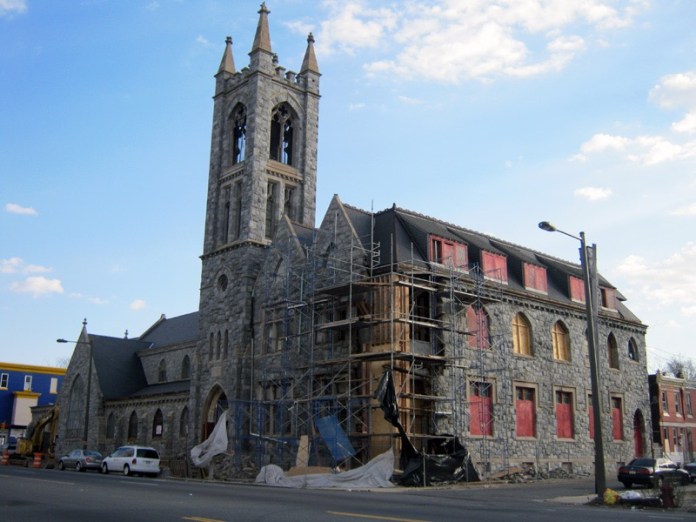
Particularly, one of the shows Kara loves is Rehab Addict. For those of you unconverted or uninitiated to the HGTV faith, the host of Rehab Addict, Nicole Curtis, is obsessed with finding historic houses and returning them to their original glory and beauty. She always tries to use original features and materials where she can find them. The idea is not simply to flip a house and make a profit. It is a labor of love, spanning months and months, whose end result is to place back on display the original beauty and splendor of houses as they were originally built.

I compare this to how I’ve noticed houses are often “rehabbed” today. In our neighborhood, houses are being bought, redone, and sold for a huge profit margin. The house that we recently bought in Highlandtown was done similarly—modern feel, new kitchen, recessed lighting, etc. But I wonder: what could we be losing in this obsession with what is new and modern?

This has been an idea that I’ve been sitting on for awhile now, and it’s related to my own story. Part of my own motivation in getting involved in church planting (starting a new church) was because I felt like the Church was in need of renovation. How many of you have lived in a house while noticing all of the little issues with it? And you long to fix what’s wrong, but as you dig deeper, you start to notice the wiring is bad, and the wood is rotted, or that ugly, fake wood-paneling has to go—and before you know it, you’ve ripped the house apart?

In my idealism and younger days (though I like to thing I’m still kinda both!), I was convinced I was right and that finally, we were going to get the church right. And I had pretty much one tool: a sledgehammer. As a church planter, you can decide what you want to do and how you want to do it without the nuisance of other people in the church telling you what they think or questioning it. So I felt like we were starting with a gutted house; a clean slate. We didn’t sing at first because I was so burned out on the worship music machine, that if I heard one more song by Chris Tomlin or Hillsong, I was going to scream. We met in an Irish pub to worship, mostly because it was free and the food was amazing, but also to make our Baptist friends nervous. I would find myself talking a lot about what we weren’t, rather than what we were. I was proud that we were stripped down; I was proud that we didn’t sing.

It wasn’t until I started actually studying the history of the church with more depth and a little more humility, and I started to read about the world-wide movement of the Church, that I started to realize, in horror, what I’d done: I had smashed it all to pieces-I’d deconstructed the whole thing. The baby was out with the bathwater, but so was the old claw-foot tub and the tile in the bathroom. And as a result, I had severed the line between me and brothers and sisters all over the world and across time.

In the past few years, I have come to see the value of re-examining the things that the church has done and still does; the things that we share with those who share our faith. Not just the beliefs, but the practices which both arise from and inform those beliefs. So that is what this series is about: I want us to re-examine some of the core elements of our ancient faith. I want us to fight against the desire that we often have to think that we are somehow more enlightened or advanced that those who have come before us.

So, I decided to try to teach on this and explore this in our church family, because I often teach to learn. We will be talking about Word, Prayer, Sin/Confession, and Table in the coming weeks and how we can restore them to practice and use in our community and life together. Check out the latest podcast stream on my page here and let me know what you think.

Standard
Book Notes, Holy Spirit, Musings

Book Notes: Deeper Experiences of Famous Christians

Over the holidays this past year, Kara and I got to stop and visit with my grandparents for a couple days. With sharing time between the families, we only get to see them about once every couple years, so it was a really special time for us. I have come to love and value them so much and I love sitting and listening to their stories of faith and trust in God. It makes me feel so small and realize that I have so much to learn in my journey with God.

Also, there is a bit of a tradition that my Grandfather (the “retired” Southern Baptist preacher and evangelist) has developed in calling me into his study toward the end of our time there to speak “man to man”. He always wants to make sure I am being taken care of financially and that Kara is well. And then he has this way of asking me really good questions. “Son,” he would begin, “what do you know about the Holy Spirit?” I stammered through my answer, not sure where the question was coming from. I spoke theologically and experientially and after I realized I was out of things to say, I just stopped talking. (for those of you who know me, this is a bit of a miracle in and of itself!)

My Grandpa sat back and said, “Son, I can tell that you are searching and seeking right now,” Boy, was he right. He started telling me stories of his own experiences with the Spirit, with men he respected who came to meet with him and were able to answer all of his questions without him having to ask a single one. He then pulled this book off the shelf and opened it up.

As you can tell, both the previous owner (who gifted his library to my Grandpa when he was fresh out of seminary) and my Grandpa deeply treasure this book. He was very quick to tell me, “I’m not giving this to you—it’s a loan, so return it!” He said that this book continues to shape his experience and understanding of the work of the Spirit upon the lives of people in the church.

And it was incredible to read. A few thoughts (and I’m still churning this around in my mind):
There is ONE Spirit– I was so taken with the commonality of experiences with the Divine which spanned time and denomination/tradition. Beginning with the Scriptures and the moving through the Apostolic age, people from so many branches of the Church were featured (Roman Catholic, Anglican, Methodist, Anabaptist, Reformed, Presbyterian, Baptist, Lutheran, Quaker, Salvation Army, etc.) ***although, the author’s bias would often show itself toward the “high church” traditions and he often was not too fond of the Roman Catholic church
The Spiritual life is a similar journey, yet unique to all– In almost every account, there was significant struggle in early life and a deep-seated desire to have “more” of God. However, the path of discovery and experience was different. For some, they had ecstatic experience or the “strongly warmed” feelings of Wesley. For others, there was a gradual and prayerful trajectory toward God, spurred on by little moments.
Sin is an obstacle to Spirit-filled living-Most every life outlined in these pages displayed some struggle against sin. Whether it was continued practice in sin or living with sin unconfessed or significant pride or apathy, everyone had to surrender significantly to better participate in the life God was calling them to live.
God works through Spirit-filled and Spirit-guided people, not simply the “best”-Most of the biographies outlined in the book were of ordinary men and women of ordinary means. Many were unschooled and were living fairly insignificant lives. Yet when God’s Spirit got ahold of them, thy were used to do incredible things. Their fame was the result of the Spirit’s work in them, not the other way round.

So, what do I know about the Holy Spirit? Simply, that I want and need more.

Standard